Sunday, 13 September 2015

5 Favorite Bloggers..!

Social media is a big platform to inspire people, communicate and share one’s experiences, opinions and thoughts to the masses. I have a handful of blogs saved in my bookmarks and I really enjoy reading them all, but there are a special few that make my heart flutter when I see a new post. I follow them devotedly and take tips from them on how to get my life in order and keep myself aware of the things happening in the world outside. And of course, stating the obvious, taking fashion and beauty tips, finding the most exotic restaurants in town and go places.

So, here the list of my favorite bloggers: -

1. Kayture by Kristina Bazan


Kristina Bazan, 21, a Swiss Blogger, influencer, model, stylist, creative director, and most recently: a singer. She has an impressive reach and a major presence on Instagram with about 1.1 million likes. The most impressive thing about her is that at a very young age, she has achieved something that most people can’t. This inspires me to look up to her as an icon. Also, she possesses the European elegance and a luxurious style, by wearing and working with a selective variety of high end brands, ranging from Louis Vuitton, Dolce&Gabbana, Yves Saint Laurent and Dior to Mango, Guess, and Jimmy Choo. She stood out from the crowd by being one of the world’s first influencers to partner with high luxury brands including Chopard, Piaget and Cartier, and attending exclusive events such as the Cannes Film Festival, and the Spirit Awards. By focusing on editorial-quality posts, Kayture has gained a unique reputation in the fashion industry, and was featured on major magazines like Vogue, GQ and Cosmopolitan.
In addition, perpetually travelling all over the world, she shares her frenzy for fashion, beauty and lifestyle with millions, opening a window to her luxurious and colorful world.

2. Song of Style by Aimee Song


Aimee Song, 28, is a Los Angeles based Interior Designer/Blogger who initially began writing about interior design but later diversified and started blogging about different genres like fashion, beauty, travel, health and fitness. What I like about her blog is that she shows a wide variety in her posts, her style of writing is extremely engaging and I personally love her straightforward street-style shots and simple laid back outfits that seem comfortable and classy at the same time. She also has an incredible reach on social media platforms and I occasionally follow her Youtube channel where one can get the perfect styling and beauty tips.


3. Neginmirsalehi.com by Negin Mirsalehi


Negin Mirsalehi, a personal-style Dutch blogger known for her fabulous closet, her fondness for Valentino Rock studs and CĂ©line sunglasses, and her flawless Disney princess head of hair that have always attracted me. Negin describes her style as mostly casual chic. Looking at her pleasing photographs in the world’s most exotic destinations, it is hard to disagree. Yes, her looks are quite casual, yet there is always that touch of exquisite elegance that makes each of the ensembles more outstanding. She admits changing her style from time to time. For instance, she might wear a super romantic frock today and then go for an edgy look the next day. Her blog is immensely delightful and her particular style of blogging -- photo-heavy posts featuring beautiful outfits and model poses has always influenced me as a reader.


4. The Style and Pepper Blog by Jessie


“Style & Pepper is the space where I share creative advice for a flavorful life, and I truly hope that it can be a source of inspiration & encouragement to the lives of those around me.  Feel free pull up a chair while you read about “the why” behind what I do, and I’m looking forward to giving you a little glimpse behind the scenes!”

Well, if one follows the Style & Pepper blog, it would be really hard for them to disagree with the statement written above.  Jessie is a New York based blogger who runs this extremely informative blog in a fun and creative way. She shares her own personal style, DIY posts, healthy cooking tips, adventures as a style expert & much more. Her style of writing is also extremely engaging.


5. The Style Edge by Santoshi Shetty


The Style Edge by Santoshi Shetty, based in India, is like a visual diary wherein she posts about her daily style and looks.
“As an Architecture student, I have grown to love design. In architecture school I have learnt to experiment with my spaces, this has also helped me immensely with my personal style.”
The Style Edge is a personal style blog wherein the blogger shares how as a student one can stick to budget, restyle outfits and still create looks that are perky and fun. This, according to me, is one of the best things about the blog. It is a good place for getting quick style tips that can easily fit into one’s budget.

Tuesday, 1 September 2015

To Indian Parents, from an Indian Daughter…

Ever since a girl is born, the dream of getting married is cultivated in her. The feeling grows with her that one day she would have a life of her own and have a life like that of her parents. In India, It wouldn’t be a stretch to say that the word ‘marriage’ in many languages is the first word the child learns after Mummy and Papa. For some the experience is everlasting while for others it becomes a nightmare.

For an Indian the word Marriage is a matter of karmic destiny. Arranged marriages in India is a trend being followed since ages wherein the parents decide with whom should their children be spending the rest of their lives, without having known that person.

I came across a foreign national a few days back who started this conversation and gained my attention on the seriousness of this strange scenario that I never thought of before. To a large extent his views on this tradition seemed right and influenced me to think and write about it. “I have only seen this in your country that people get married without knowing each other, this is strange”, the foreigner said and continued,  “Marriage is for happiness and not for compromises”. At first his words instigated, however, as and when he started to elaborate his views I bought his points and he actually changed my perception towards this tradition, which I thought was right earlier.

Trends have certainly changed in India over the years however, a major part of the population in India still believes in this tradition that has resulted in an increased rate of Divorces in India. Here another emphasis is not on “Love marriages” because we have seen separations happening in many successful love marriages too but the ratio is less in comparison to “Estranged marriages”.

But like everything, arranged marriages have both pros and cons. On one hand, in arranged marriages there are lesser ego related issues. However, nothing in this world comes for free and one does not understand this unless they are made to “PAY”. The whole idea of arranged marriages also draws my attention to the cause of other problems faced by people in India. Parents dedicate half of their lives in raising their children, giving them best of education and living and spend the other half searching for prospective brides and grooms for their sons and daughters. This forces me to highlight the issues like caste system, dowry-deaths, suicides, cyber crimes through matrimonial websites and so on. The list is never ending. The biggest threat that arranged marriages face is that if either the boy or the girl is not ready for the marriage, it can lead to serious trouble. This may even cause resentment and emotional setback for both of them. Moreover, such a situation can even make a person get avert to the idea of marriage itself. The main reason behind such a condition is pressure from the family and parents. Thus, parents should understand that in lieu of being over authoritative they could ruin their children's life forever.

If one goes by the statistics, 69% marriages are still arranged in India. Arranged marriages also call for huge ceremonial dramas and unnecessary waste of money wherein the bride’s family are the givers while the groom’s family are the takers. Its been quite unfortunate for the Indian society to think that giving dowry in the form of cash, gifts, ornaments etc. ensures a happy, long and ‘respectable’ life for their daughters, while the irony is that giving dowry invites more expectations and greed from groom’s family. Statistics show that over the years, the wedding arrangements from both the parties are being done to have upper hand in the society. While, it should have been done for the happiness of both bride and groom and for their good future. It has often been seen that families also take loans from banks and even mortgage their properties to make wedding arrangements. Such is the mentality of the Indian society and its extremely sad.

Marriage is a sacred bond that is meant for the union of two people who decide to stay together in a commitment for their entire life despite of all odds from their families, however, Indian society has changed the literal meaning of marriage wherein not only two people but their whole families get married to each other to flaunt their social and financial status in the society.
However, we are not saying that the concept of arranged marriages is bad if it involves lesser drama and promotes better understanding between the consenting adults in terms of mental, physical and emotional considerations. In fact, arranged marriages also have benefits. There is reduction of incompatibilities - same religion, caste, dietary preference, linguistic group, socioeconomic background, etc. Following one's head is often wiser than following one's heart - love can just be an infatuation. Low expectations- neither spouse knows exactly what to expect, so they are often pleasantly surprised by how good their marriage is.

To conclude, I would repeat, “Marriage is for happiness and not for compromises”. With changing concepts of society, added stress and the changing role of the Indian Women, marriage in itself has become more of a challenge than ever. Marriage like two sides of a coin comes with advantages and disadvantages. These are not only dependent on the marriage types but the partners as well. Parents should also understand that they are not living in the savage age and should accept that their children are literate and mature enough to choose their life partners. Parents should show enough confidence in their children that they have given them best of morals and values and a good upbringing that will help them to take right decisions in life.


Headlines: -

1.  What it’s really like to have an Estranged Marriage…
      2.  Modern Indian Men and Women Struggle with Arranged Marriages.
      3.  Arranged Marriages In India – A Bliss or a Curse?
      4.  To Indian Parents, from an Indian Daughter…
      5.  Arranged Marriages – Unison of Families or Individuals?
      6.  Marriages in India – For Happiness or a Compromise?


Fashion in the Dark Ages

The Early Middle Ages, also known as the Dark Ages, or medieval times, refers to the period in European history after the fall of the Roman Empire. The phrase “Middle Ages” is used to describe Europe between the fall of Rome in 476 CE and the beginning of the Renaissance in the 14th century. When the Roman Empire fell in 400 CE, the once unified continent fell into chaos. The roads that had been constructed by the Romans fell into ruin and were plagued by highwaymen. Commerce and industry declined rapidly and governments lost revenue and were unable to maintain order or protect people, property and the trades.
Clothing in the ‘Dark Ages’

Many aspects of the clothing used in ancient Europe in the period remain unknown. What we call fashion today, did not exist during the Early Middle Ages and clothing styles were more perpetual and steady; they did not change as quickly as they did in the Late Middle Ages as people of a lower economic strata did not attempt to emulate the elite.


Clothing of Medieval Common People

Serfs, peasants, and low skilled workers wore a tunic made of cloth or leather and an over tunic in colder weather. Serfs went barefoot or wore sandals. Sumptuary laws placed restrictions on the types of clothing worn by the lower classes but they were rarely enforced. The poverty endured by the lower classes was enough to prevent them from attempting to imitate their betters. The use of ornate fabrics and embellishments increased with the wealth of the wearer. The clothing of the lower classes was usually made of woven wool. Garments were made out of fabrics woven at home.


Clothing of Wealthy People During The Middle Ages

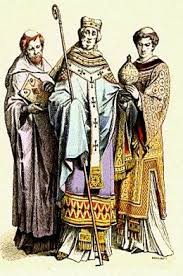
The garments of the upper classes in the Dark Ages were made of finer fabrics. Wealthy people and the aristocracy took pride in their appearance by wearing attractive clothing. Just like today, the elite wore fine fabrics and ornamentation as status symbols. Their tunics were made of linen, which was lighter in weight than wool, and thus, more durable, comfortable and easy to launder. Linen was made from fibers of the flax plant. The difficulty in the production of linen meant that the material was more expensive to purchase and more time consuming to make than the wool worn by common serfs. Merchants, artisans, and other freemen wore higher quality garments than serfs, but not as fine as those worn by the nobility. Under and over tunics made of different colors created a stylish appearance. Hems, necklines, and sleeve edges were often decorated with borders to add interest and a beautiful clasp added panache to a plain cloak. Cloaks could be lined or edged in fur for warmth and also as a symbol of wealth and high status.


Medieval Men Fashion and Clothes

There was little difference between garments worn by men and women. Women's tunics were longer and resembled a gown. Men however, wore trousers under their tunics. This was a style that had differentiated the Northern European dress from how it was worn by the Romans. Straps made of leather or straw and wrapped around the lower leg protected both the leg and trouser from damage. The length of men’s tunics depended upon their occupation. Laborers wore shorter tunics than those who performed more refined tasks. 


Medieval Women Fashion and Clothes

The Women's Fashion of the early Middle Ages was still influenced by the classical styles of the Greek and Roman. The female clothing of the time consisted of two tunics, the under tunic being longer but less capacious than the other. Women also wore a long cloak over their clothing and closed shoes. The Church mandated simplicity in women's clothing, hairstyles, and accessories. Elegance began to be stated in women’s gowns. Women wore veils or head coverings for modesty as dictated by the Church. However, over the years, veils became more complicated and evolved into elaborate headdresses in the later Middle Ages. Outer wear for colder weather included capes and shawls. These were simple garments made of wool or leather. A cape could be tossed over the shoulder and held closed near the neckline with a brooch. 


A few illustrations that I made: